Immigration Law | Criminal Defense | United States
Hardam Tripathi | TripLaw | Updated 2026
How Criminal Charges Can Impact Your Immigration Status in the U.S.
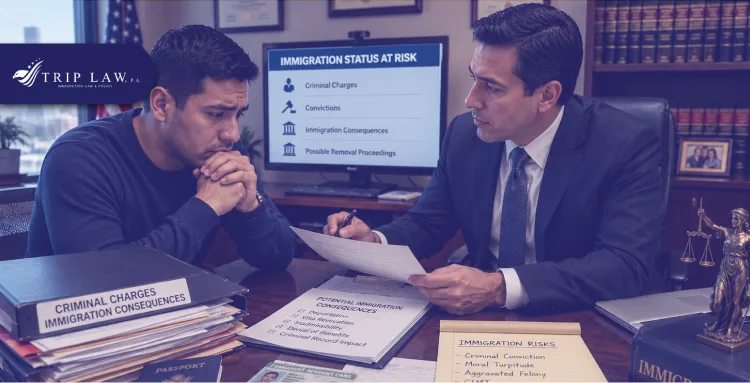
Legal and immigration-related online resources explaining how criminal charges, convictions, and court proceedings may impact visa status, residency, and deportation risks in the United States.
A criminal charge could jeopardize your legal status in the U.S. and may result in deportation, cancellation of your visa, or denial of future immigration benefits, including a green card or citizenship. The effect depends on the specific crime, the nature of the conviction, and how U.S. immigration law classifies the offense.
For noncitizens, the criminal court result is only one part of the story. Immigration agencies can review arrests, plea deals, probation terms, old cases, and travel history when deciding whether someone can stay in the United States or receive a future benefit.
Key Takeaways
- A single criminal charge, even a misdemeanor, can seriously impact a noncitizen's immigration status.
- State court dismissals, withheld adjudication, or light sentences may still be treated as convictions under federal immigration law.
- Federal aggravated felony rules can be broader and harsher than state criminal labels.
- A DUI may not automatically cause deportation, but it can trigger visa revocation, extra scrutiny, or removal risk when other facts are present.
- Hiding old arrests or convictions on green card and naturalization applications can create separate fraud and deportation problems.
- Waivers of inadmissibility may be available when a qualifying U.S. citizen or lawful permanent resident relative would suffer extreme hardship.
- Good Moral Character is usually reviewed across the five years before Form N-400, so timing and preparation matter.
1. The Conflict Between State Criminal Laws and Federal Immigration Policy
Criminal courts focus on punishment, rehabilitation, and public safety. Federal immigration authorities focus on whether a noncitizen should be admitted, allowed to remain, or removed from the United States. These two systems often use different legal definitions.
A state judge may give a light sentence for a first offense, or a prosecutor may offer a plea that sounds favorable. Immigration law can still treat that outcome as a serious problem. A dismissal, withheld adjudication, or no-jail sentence may still create an immigration conviction if the federal definition is met.
Only about 1.83% of new immigration court filings in early 2026 were initiated on criminal grounds, showing how federal removal cases often turn on immigration-specific rules rather than state criminal labels.
Source: TRAC Immigration
We review arrest records, statutes, plea language, sentencing documents, and immigration history together. That level of detail matters because a local plea bargain that seems helpful in criminal court can quietly damage visa status, green card eligibility, or future citizenship.
Aggravated Felony Categories
Under federal immigration law, certain offenses receive an aggravated felony label even when the state court uses a different classification. This designation can lead to mandatory detention, removal, and loss of many forms of relief.
The phrase can be misleading. Some offenses that state law treats as misdemeanors may still create aggravated felony consequences if the sentence, loss amount, or statutory elements meet the federal standard.
State Plea Bargain Risks
A deal that avoids jail time can still hurt a visa holder. The exact wording of the plea, the admitted conduct, and the sentence can matter more than the informal name of the charge. Before accepting any plea, noncitizens should understand the immigration result, not only the criminal sentence.
2. Definition and Scope of a Crime of Moral Turpitude
One of the most confusing immigration terms is crime involving moral turpitude. It does not have one simple definition. Courts often describe it as conduct that is inherently base, vile, or contrary to accepted moral duties between people.
Fraud and theft usually fall into this category. Certain assault, domestic violence, and intent-based offenses may also qualify. This classification can determine whether a visa application, adjustment of status case, green card renewal, or naturalization application succeeds.
Subjective Legal Standards
Because moral turpitude is flexible, prosecutors and immigration officers can view the same record differently. A careful defense challenges overbroad classifications and compares the specific statute to prior immigration decisions.
Entry and Re-entry Restrictions
A conviction for a crime involving moral turpitude can make a person inadmissible. That may block a visa renewal, prevent re-entry after travel, or create problems with a lawful permanent resident application.
USCIS guidance explains that admissibility is generally required for admission, adjustment of status, and many immigration benefits.
Source: USCIS Policy Manual
3. Specific Immigration Consequences of a DUI
Many people assume a driving offense is minor. For someone who is not a U.S. citizen, a DUI can affect immigration status even when it does not automatically lead to deportation by itself. It may still cause visa revocation, travel delays, discretionary problems, and questions about rehabilitation or good moral character.
DHS has reported recent ICE arrest data showing a major share of interior arrests involving individuals with either criminal convictions or pending criminal charges.
Visa Revocation After Arrest
Consulates may revoke visas after a DUI arrest, even before a criminal conviction. That does not always mean the person must leave immediately, but it can create serious problems for future travel, visa renewal, or consular processing.
Controlled Substance Violations
A DUI involving controlled substances is far more serious than a basic alcohol-related charge. Drug-related facts, child passengers, injuries, probation violations, or repeat offenses can quickly increase the risk of removal proceedings.
4. Green Card Renewal with a Criminal Record - Success Steps
If you already have a criminal record, you may still have options. Many people assume they are stuck forever, but some cases can be explained, rehabilitated, waived, or strategically timed.
Green card renewal with a criminal record is stressful because the application requires full disclosure. The government can see arrests even if a judge dismissed the case. Certified court records, police reports, probation documents, and final dispositions often become essential.
Disclosure Requirements
Hiding a past arrest is often worse than the arrest itself. Misrepresentation can become an independent immigration problem. A truthful application supported by accurate records gives the government a clearer path to understand what happened.
Evidence of Rehabilitation
Rehabilitation evidence can help show who you are today. Strong records may include proof of steady employment, tax compliance, treatment completion, community service, letters of support, and documentation showing family and community ties.
5. Naturalization with a Criminal History - Path to Citizenship
The journey toward U.S. citizenship is long and requires careful preparation. By the time someone applies for naturalization, the government will review immigration history, travel, taxes, family obligations, and criminal records.
If there is a criminal issue, the naturalization process becomes more sensitive. USCIS may review whether the applicant was properly admitted, whether any inadmissibility grounds exist, and whether the person has shown Good Moral Character during the statutory period.
Eligibility for Waivers
When a criminal issue creates inadmissibility, a waiver may be available in some cases. Waivers allow the government to overlook certain past mistakes when the legal standard is met, often including proof that removal would cause extreme hardship to a qualifying relative.
USCIS recognizes that waiver decisions require a hardship analysis for qualifying relatives and a review of the full facts of the case.
Source: USCIS Extreme Hardship Policy
Background Check and Good Moral Character
Form N-400 requires a deep background review. USCIS can examine criminal history, tax compliance, travel, family support, and honesty throughout the process. For many applicants, the key period is the five years immediately before filing, though older conduct may still matter.
USCIS states that many lawful permanent residents applying under the five-year rule must show Good Moral Character for at least five years before filing Form N-400.
Source: USCIS Naturalization Eligibility
Quick Risk Comparison for Criminal Immigration Cases
| Criminal Issue | Immigration Risk | Defense Step |
|---|---|---|
| Dismissed or withheld case | May still count as a conviction for immigration purposes | Review the plea, sentence, and court record before filing any immigration application. |
| Aggravated felony | Can trigger detention, removal, and loss of common defenses | Analyze the federal immigration definition, not only the state charge name. |
| Crime involving moral turpitude | Can affect admission, re-entry, green cards, and citizenship | Check whether the offense involves fraud, theft, intent, violence, or other aggravating facts. |
| DUI arrest or conviction | May cause visa revocation or serious discretionary problems | Look for controlled substances, injuries, child passengers, prior offenses, or probation terms. |
| Hidden arrest history | Can create misrepresentation and credibility issues | Disclose accurately and support the case with certified records and rehabilitation evidence. |
If Criminal Charges Are Affecting Your Status, TripLaw Can Help
Criminal immigration problems move fast. A plea in state court, a trip abroad, or a rushed immigration application can create consequences that last for years. TripLaw reviews both the criminal record and the immigration history so the strategy fits the whole case.
- Review criminal court records before immigration filings or travel.
- Coordinate with criminal defense counsel before a plea is accepted.
- Prepare waiver, green card, and naturalization strategies after an arrest or conviction.
Your Status, Your Family, and Your Future Are Worth Defending
TripLaw helps clients across the United States understand how criminal charges affect immigration status, residency, and citizenship. Get legal guidance before a plea, travel decision, green card filing, or naturalization application creates avoidable risk.
Call (863) 599-6735
1543 Lakeland Hills Blvd, Ste. 17, Lakeland, FL 33805
Free Consultation | trip-law.com
Frequently Asked Questions
People Also Ask About Criminal Charges and Immigration Status
Can immigration authorities use old criminal charges against me years later?
Yes. Immigration agencies can review past arrests and convictions during visa renewals, green card applications, airport re-entry screenings, and citizenship interviews. Even older cases can become relevant when they appear in a background check.
Does traveling outside the United States become risky after a criminal charge?
It can. Some noncitizens face problems returning to the U.S. after international travel because border officers reassess admissibility at the port of entry. A state criminal case that seemed resolved may still trigger immigration review.
Can a plea deal create immigration problems even if it avoids jail time?
Yes. Certain plea agreements carry immigration consequences regardless of jail time. The offense wording, sentence length, and federal classification can all affect whether you can stay in the United States.
Can I renew my green card with a criminal record?
Possibly, but you should not file blindly. USCIS can review the full criminal history, including dismissed arrests. A legal review helps determine whether a waiver, court document, or rehabilitation evidence is needed.
Will one DUI make me deportable?
A single simple DUI does not always create deportability by itself, but it can cause visa revocation, travel problems, and discretionary issues. A DUI involving drugs, injury, a child passenger, or prior offenses is much more serious.
Disclaimer: This article is for general informational purposes and does not form an attorney-client relationship. For help with any immigration issue, reach out to Trip Law.